The Roman Empire’s most brutal and infamous method of execution
Easter is a period that reminds us that there was once a time people went through the most excruciating form of torture to be executed. Let me tell you something I have gathered so far about this form of execution!
In 73 BCE, there was a famous passway known as the Appian Way, where travelers see crucified bodies stretch for over a mile. These were the defeated followers of Spartacus, executed after their failed rebellion against Rome. Around 6,000 men were nailed or tied to crosses, left to die slowly in full public view. Their bodies were not buried but abandoned to be consumed by animals. For months, one of Rome’s busiest roads became a haunting symbol of state terror.
Although crucifixion was not originally a Roman invention. Its roots stretch back to earlier civilizations like the Assyrian Empire, and it was later adopted from the Carthaginian Empire. But no culture embraced and institutionalized the way Rome did. Romans used crucifixion as a calculated system of punishment designed not just to kill, but to also degrade, intimidate, and control.
Even Roman elites themselves knew that crucifixion was horrific. An orator named Cicero at that time declared that the very word “cross” should be avoided by Roman citizens altogether. This kept Romans citizens under fear and constrained from being rebellious.
But wait! Do you know why it is the most excruciating way of execution? If not, let me briefly walk you through it then.
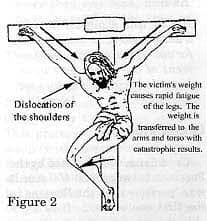
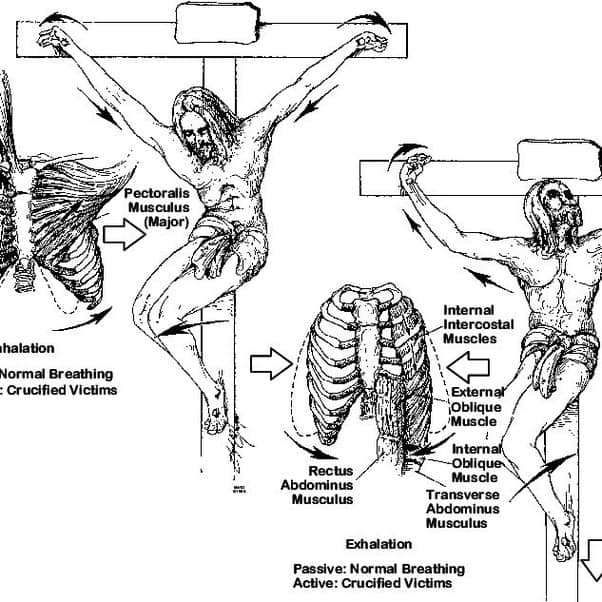
Well, after one is nailed or tied to a cross, the victim’s body weight is pulled downward, forcing the arms into an elevated, and stretched position as in the image above. This position makes breathing extremely difficult. So to inhale, the person had to push up against nailed feet or strained legs to lift the chest and expand the lungs. But this movement caused intense pain, especially if nails had been driven through the wrists or heels.
Over time, the muscles responsible for lifting the body weakens, making it harder to breathe. Eventually, the victim will no longer be able to push upward, leading to asphyxiation also called suffocation and this is the primary cause of death in many cases. Death could take hours to days. In some cases, Roman soldiers hastened it by breaking the victim’s legs, preventing them from pushing up to breathe – just like in the story of the two thieves that were crucified with Jesus. This brings a quicker end to the person’s life through suffocation.
Yes! It was this deadly and because it was culturally avoided among Romans, much of what we know about crucifixion comes from non-Roman sources, such as Flavius Josephus and early Christian writings like the New Testament of the Holy Bible.
The practice of crucifixion reinforced the dominance of Rome’s ruling class while reminding subjects of their vulnerability. Those mostly affected were slaves, rebels, and non-citizens. In fact, Roman citizens were largely protected from crucifixion, showing how the empire was socially divided.
What was more shocking to me was that an entire family, communities, or even bystanders could be executed simply for being associated with rebellion. According to Josephus, people living in rebellious regions were usually crucified indiscriminately. This meant that anyone, guilty or not, could become a victim.
The widespread use of crucifixion peaked between the 1st century BCE and the 1st century CE, which was also the period that saw the execution of Jesus Christ. His crucifixion remains the most famous example, forever linking the practice to Roman authority in global memory.
Comments (0)