What Do You Know About Nigerian Pyramids?
I can still remember my grandpa telling me how they walked through famous African leaders, their shoulders high, as the nation that fed nations. Obviously, you don’t expect me to give in to such tales now, especially having lived my life in alternating and accelerating seasons of hardship in Nigeria. I’m not entirely always skeptical about information like this, but most of the time I appreciate reality more than fantasies. For me, I care less about the past because I live in the present, but that changed last month when I stumbled on what appeared to be an interesting piece of Nigerian agricultural history.
I got into an argument in which I argued that the pyramid of Gaza in Egypt isn’t the only popular pyramid in Africa. Before now, I knew a pyramid once existed in Enugu, southeast Nigeria, but upon a deep search for proof, I learnt that we once had the largest groundnut pyramid in the world.
Yeah! I was as shocked as you are.
According to the little research I did afterwards, Nigeria was one of the world’s largest exporters of groundnuts in the 1950s and 1960s. Groundnuts (peanuts) from northern Nigeria were processed into vegetable oil, animal feed, and industrial raw materials, and shipped to Europe and other parts of the world. As of that time, the crop was the backbone of the Northern region’s economy, and its proceeds funded education and public institutions.
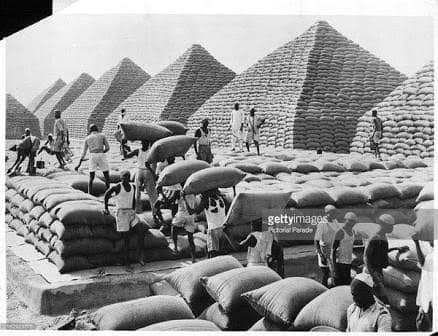
Due to the quantity of production in the ancient commercial city of Kano, groundnut pyramids were created. This pyramid consists of carefully stacked sacks of groundnuts serving as functional storage systems that will preserve their quality before export. Legend has it that some pyramids reportedly contained up to 15,000 to 20,000 bags each, which is equivalent to two to three storey buildings. Then, the pyramids stood proudly near the railway lines that connected Kano to the southern ports, especially Lagos, from where ships dispatched it internationally.
By the early 1960s, agriculture accounted for more than 60 percent of Nigeria’s GDP and over 70 percent of exports. And in this figure, groundnuts were among the top contributors, alongside cocoa from the West and palm produce from the East. The economy in those eras was regionally competitive and diversified until oil came.
The discovery and commercial exploitation of petroleum in the Niger Delta dramatically shifted Nigerians' economic focus. And so by the 1970s, national investment and policy attention had shifted away from agriculture toward the oil boom. Following the Nigerian-Biafran civil war, groundnut production declined. And ultimately, the pyramids gradually disappeared as they were dismantled naturally when output fell.
That was the end of the supposed proud heritage that represented Nigerian’s commitment to agriculture. What remains of this heritage are pictures that remind us of the time when we ruled the world in agriculture. For me, it was an interesting find, and every minute I spent reminiscing over it was all worth it. The history of Kano's groundnut pyramids is a legacy that every Nigerian should be proud of.
Yes, we once fed the world!
And that means we can do it again when we want to.
Comments (0)